Keep Your Wires Ordered

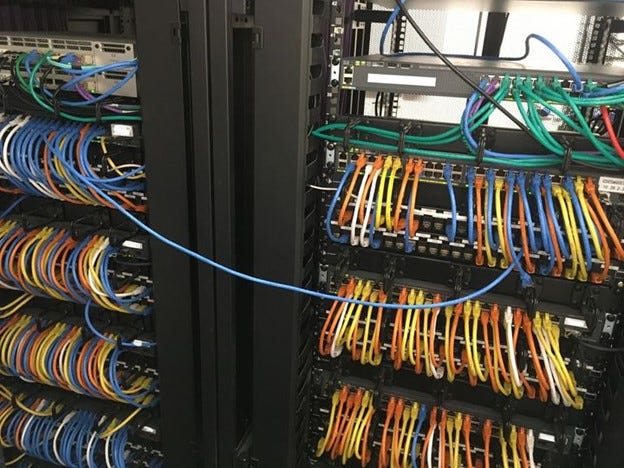
On one of my socials, a friend who is also a network administrator, posted this image of a network with one wire blatantly run out of pattern, and above it wrote "I know a tool that does this." The image struck a deep philosophical blow upon my psyche, while the comment encapsulated a profound philosophical perspective.
In this image, all the other wires represent a set of rules and protocols, while this wire represents an exception. A disaster always begins with a first exception. One pragmatic action opens the pathway for another, and another, and another, and so on. Before you realize what you have allowed, the web of exceptions has spiraled into chaos, and you must work twice as hard to unwind your mess.
We create rules and protocols for a reason. Everything is easier, and everything runs smoother when there is a clear progression of actions and consequences. Ayn Rand said that contradictions do not exist. "Whenever you think that you are facing a contradiction, check your premises. You will find that one of them is wrong," she said. It means that whenever you perceive a contradiction, you are identifying a flaw of perception rather than an exception to reality. The problem is in your mind, not in the world.
An exception to a rule is a type of contradiction. If you perceive the need for an exception to a rule, then either the rule needs to be re-examined, or your perception of the need for an exception needs to be re-examined. Either the rule needs revision, or you need to find a different way. This is how innovation happens. This is why man invents tools; to do things that would otherwise disrupt the order that he has created for managing his productivity.
Man cannot have one wire running outside the pattern, because then breaking the pattern becomes the pattern. Innovation does change patterns too, but it does it in a more measured and ordered manner. Innovation is not haphazard. It does not look random. It has a goal and a set of parameters that direct its creation and its function. An innovation creates a new rule. We used to do it, (whatever it is,) one way, and now we do it in this new way. We still have order. Our productivity is still efficient and smooth. Nobody should have to remember any exceptions or special cases. Smart people make difficult tasks seem simple by simplifying them. A smart mind may seem like a lazy mind because, it does a little extra heavy lifting in order to spend a lot more time relaxing.
Tools restore our energy and effort. They give us back our time so that we may pursue other endeavors. Then we take that extra time and that extra energy and use them to create more tools, to save more time and more energy. The purpose of a life is to be productive. The better your tools, the more productive you can be, and the better life can be as well.
In the 1980's my mother was working for Doubleday publishing. The author Arthur Hailey wanted to be able to send his manuscripts to the publisher without having to print them out. My mother was sent to his home in the Bahamas to set up his internet connection. This was the first implementation of that type of technology in Doubleday's history. My mother spent most of a week there figuring it all out. She asked to see his home office so she could figure out how to set up a dial-up connection. It was all new back then. But I'm telling this story for a different reason.
Hailey's desk was set up in front of a big picture window that looked out on the Mantuga Bay. He confided to my mother that sometimes he just sat there with his feet up on the desk, staring out the window while he thought about the story he was trying to tell. He said that at times like those, it was awfully difficult to convince his wife that he was actually working. But he was working. And he had worked very hard to get to that place in his life. He had several regular jobs before he became a famous writer. Every night back home in Toronto, after a full day's work, while his wife cleaned up from dinner and his kids ran around causing a ruckus, Hailey would sit at the dining room table for hours, writing poems and plays and stories that didn't garner a great deal of success. But then, in 1955 he wrote “Flight Into Danger”, which was optioned by the Canadian Broadcasting Corporation, and went on to garner international acclaim. That led to a string of more successful stories, which eventually led to the novel Airport in 1968, and the rest is history. He did the work, and that bought him the time. And the more time he bought, the better his work became, and the more time he earned.
Productive people remove obstacles. They do not put them in their own way. A productive person gathers enough information about how things have been done, in order to figure how they can do them better. Adaptation is the hallmark of productivity.
One of the problems which Arthur Hailey had perceived with sending a printed manual to his publisher, was all the type-o’s that wound up in his galleys. He figured that if he could send the manuscripts in to Doubleday, untouched by human hands, then there would be less flaws that crept into the galleys for the completed novel.
”Okay,” my mother pointed out. “But your manuscripts often include words from foreign languages. and those words sometimes have accents or umlauts or other symbols. But the word processor that you have been using doesn’t have keys for that. How do you get those symbols into your manuscripts?”
“I print them and then mark the symbols on the page with a pencil.” Hailey did not miss the irony of his own remark. After sharing a laugh, my mother had to get him a real computer and teach him how to use the special symbols for foreign languages.
A system reliant on exceptions is doomed to failure. I have been repeating since high school some variation of the idea, that a shortcut is the longest path between a goal and success. That one wire that is run out of pattern represents a shortcut to solving a real problem. Those pencil marks on the manuscript are the same thing. It is not a real innovation. It is a pragmatic action that shortcuts innovation. You cannot patent it. You cannot sell it. It is not easily repeatable. It may work once and then never again. That's not a real solution. It is an invitation to chaos. A real innovation should provide a reliable application that can solve a specific problem more than once. It should be repeatable. It may be patentable, and it may be saleable. At the very least it should enable one or both of those actions.
"There has got to be an easier way to do this," is the operative phrase of the innovator. Never accept an exception. Always look for an innovation that will negate the requirement for an exception. It is best to keep your wires ordered. To be an innovator, shift the paradigm. Re-write the rules.